Your Meta dashboard shows a CTR of 0.45 percent. Google Ads is sitting at 1.8 percent. LinkedIn is somewhere in between. The ads have been running for six weeks with the same three images and four headlines. You are spending across platforms but you do not know which creative is carrying the weight.
Where should the next dollar go? The creative itself, more often than not. IAB research published in 2026 found 83 per cent of ad executives have deployed AI in their creative process, and the reason is straightforward. A structured creative testing system eliminates guessing. It generates variations, sets up the experiments, and lets the data tell you what works.
This is about giving your creative team an AI system that handles the volume, the repetition and the analysis so they can focus on the strategy that matters.
What happens when creative is not tested
Ad creative fatigue is measurable. On Meta, frequency is the leading indicator: when the same person sees your ad three to five times, click-through rates start to slide. That is the point where most teams refresh creative. On Google, Responsive Search Ads that use only five headlines instead of the full fifteen leave performance on the table because the platform has fewer combinations to optimise.
Companies that do not test their creative systematically end up with two problems. First, they keep running tired ads because nobody knows whether the creative is the issue or the audience is the issue. Second, they miss the small slice of creative that actually drives most of their conversions. Without testing, there is no signal.
An AI system that generates, launches and measures creative variations solves both problems. It turns creative from a guessing game into a data loop: generate, test, measure, iterate.
What AI creative testing actually looks like
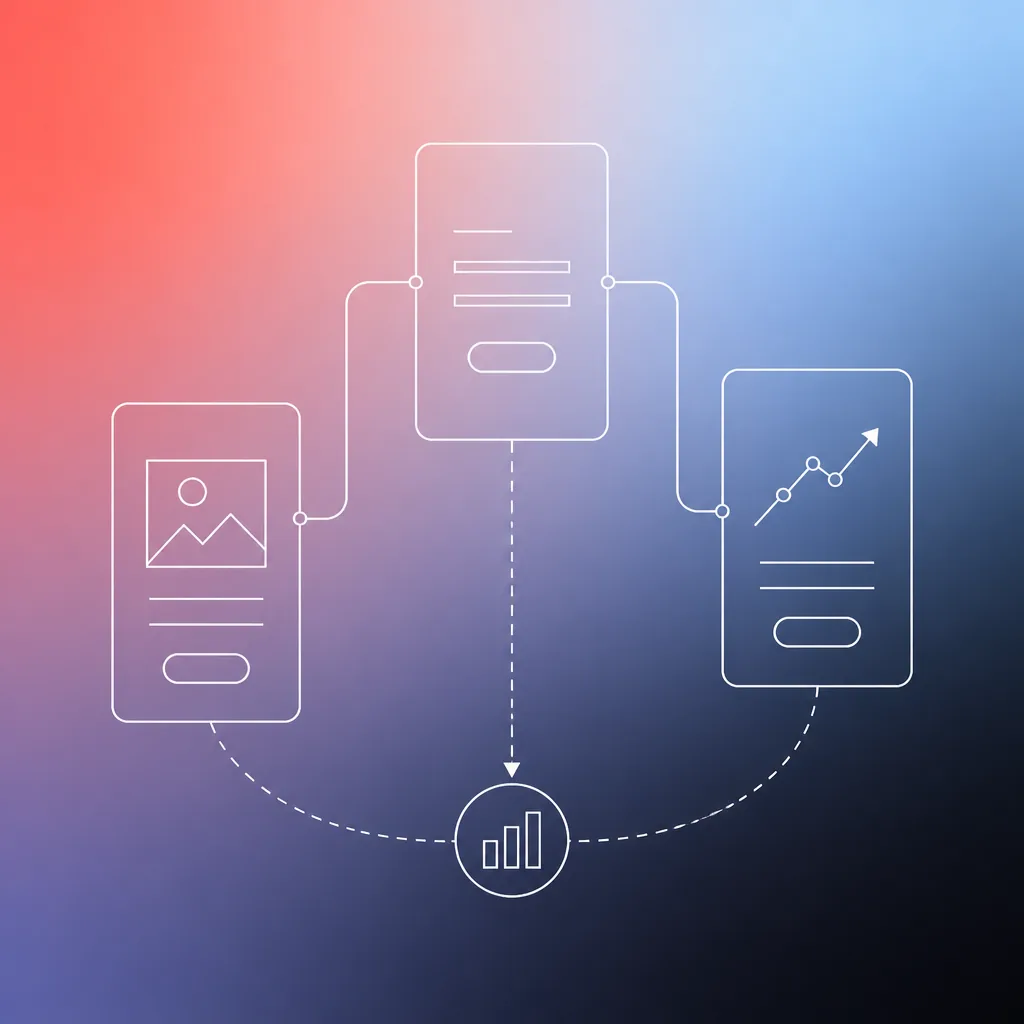
The approach runs on three stages that connect into a weekly cycle.
| Stage | What happens | Where it runs |
|---|---|---|
| Generate | A structured brief produces 10-15 headlines, 5-8 primary texts and 3-5 image concepts | ChatGPT or another LLM |
| Launch | Variations feed into the platforms via API, each test running 1-2 weeks | Google Ads RSA, Meta Dynamic Creative |
| Measure and iterate | Winners get budget, losers pause, and the next brief includes the performance data | Your reporting dashboard |
Stage 1: Generate at scale
ChatGPT receives a structured brief covering the offer, the audience, the proof points, the brand voice constraints, and a copy framework like PAS (Problem, Agitate, Solution) or AIDA (Attention, Interest, Desire, Action). From that brief, it produces ten to fifteen headline variations, five to eight primary text options, and three to five image concepts. Treat the output as raw material for testing, not final copy.
This stage replaces the manual creative brief iteration that typically takes two to three days. With AI, you get a testing slate in under an hour. The quality depends on the brief, not the tool. A vague prompt produces vague copy, while a tight brief with audience specifics and hard constraints produces variations that are genuinely worth testing.
Stage 2: Launch structured A/B tests
Google Ads Responsive Search Ads let you upload up to fifteen headlines and four descriptions. The platform tests combinations automatically and weights delivery toward the best-performing ones. Meta Dynamic Creative takes your uploaded images, headlines, descriptions and CTAs and assembles them into combinations optimised for each viewer.
The AI feeds the generated variations directly into these platforms via their APIs, fifteen headlines into Google, five images into Meta, three CTA options into both. Each test runs for at least one to two weeks to reach statistical significance. Running ten or more variations a month is the working benchmark for mature ad accounts. We could not find a published study behind that number, so treat it as the volume teams settle on to keep the loop moving, not a researched threshold. If you are still deciding where to run tests first, our Google Ads vs Meta vs LinkedIn comparison walks through the trade-offs.
Stage 3: Measure and iterate
At the end of each test cycle, the data reveals which angles, formats and offers outperform. The winning creative gets more budget. The losing creative is paused. The system learns because the AI prompt for the next cycle includes the performance data from the previous one, so the brief gets tighter each time.
The improvement compounds because the loop removes ads that do not work. Each cycle starts with a better brief and a cleaner slate than the last one. We have not found a single credible public benchmark that puts a firm number on creative testing improvements specifically, so we do not quote one. The mechanism itself is documented in the platforms' own materials. Google's RSA help and Meta's Dynamic Creative documentation both describe delivery weighting toward better-performing combinations, which is the same loop in different clothing.
What a testing loop does to your account
The most obvious change is the volume. A team that produces two or three creative concepts per month starts producing ten or more. The bigger change is the confidence. Every new creative goes live with a test behind it. You know which version is driving conversions because the data tells you, rather than because someone has a strong opinion about the headline. For a broader look at how this connects to overall ad performance, our unified attribution guide covers the measurement side of the same problem.
Where should the next dollar go? The creative that the data picked last week.
Start with one ad set this week
You do not need a full system to start. Try this on one ad set:
Write a brief. One paragraph about the offer, one about the audience, three proof points, and one brand voice constraint. Paste it into ChatGPT and ask for ten headlines in the Google Ads format (30 character limit) and five descriptions (90 character limit).
Launch a test. Create a Google Ads Experiment that splits traffic between your current ad and a new one using the AI-generated headlines. Run it for two weeks and let the data reach significance.
Calculate the gap. Take your monthly ad spend and multiply it by the percentage you suspect is going to underperforming creative. If you do not have account data to work from, a common directional starting point is 20 to 30 percent. That number is the cost of not testing. Compare it to what a structured system would cost and the case writes itself.
This is something we do at Supernodes. A two-week pilot: audit, connect, deploy, measure. You start seeing which creative angles outperform within the first testing cycle. Speak with us if it sounds like your Monday morning.
Frequently asked questions
How many creative variations should I test per month?
High-performing ad accounts typically test 10 or more creative variations per month. This ensures enough turnover to prevent ad fatigue while giving A/B tests enough data to reach statistical significance.
How often should I refresh ad creative?
Most brands need fresh creative every 3 to 5 weeks on Meta platforms, and every 4 to 6 weeks on Google. Watch your frequency metric, because when it hits 3 to 4 on Meta, performance typically starts declining. Google's RSA help documentation covers how headline combinations are weighted, which is the mechanism that makes this refresh cadence necessary.
Can ChatGPT write good ad copy?
Yes, when given a clear brief with audience, offer, proof points and a copy framework like PAS or AIDA. The best results come from using ChatGPT for volume and variety, then letting A/B test data pick the winners. Single Grain's ChatGPT ad copy guide walks through the exact workflow.
What is the difference between Responsive Search Ads and A/B testing?
Google Responsive Search Ads automatically test headline and description combinations within a single ad set. A/B testing compares entirely different strategies: one headline angle versus another, one offer versus another. Use RSA for fine-tuning and A/B testing for major creative decisions. Both are documented in Google's RSA help guide.
How long does it take to set up an AI creative testing system?
The foundation takes about two weeks. The Supernodes pilot covers audit, connect, deploy and measure. You start seeing which creative angles outperform within the first testing cycle.