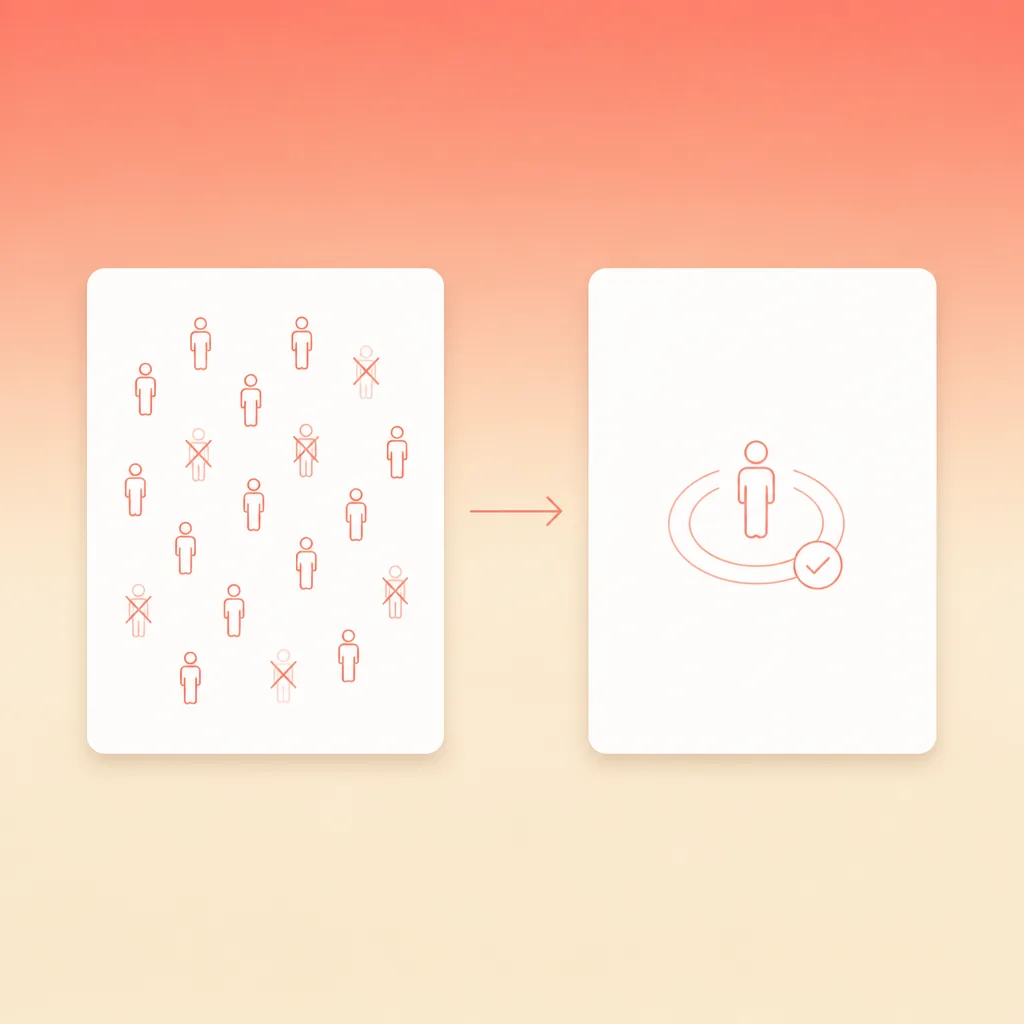
A retargeting audience on Meta or Google usually holds two very different kinds of people. One visited your pricing page three times last week and nearly booked a demo. The other clicked a single blog post in March and has not been back since. A default retargeting campaign shows both of them the same ad, at the same frequency, out of the same budget, even though only one of them was ever likely to buy.
AI retargeting is useful here for a reason most teams skip past: it can score each visitor's intent and decide who to stop showing ads to. DemandSage reports that 86 percent of marketers already use AI to retarget and optimise their funnels, so the tools are already in most ad accounts. Most of that AI is pointed at finding more people to reach. This guide covers the other use, which is building exclusion lists so the budget stops reaching people who were never buyers.
The pool those lists are carved from is large. Around 97 percent of visitors who leave a website never return, according to retargeting statistics compiled by TrueList, and 98 percent do not convert on their first visit, according to Marketing LTB. A retargeting audience built from every visitor is therefore mostly people who were never going to buy, and every impression they receive is paid for.
Why retargeting keeps spending on the wrong people
The default setup puts everyone who visited in the last 30 days into one audience, shows them two or three creatives recycled from prospecting, and sets no frequency cap. Marketing LTB's statistics note that 15 or more impressions a week can increase ad fatigue by 40 percent, and an uncapped audience reaches that number quickly. What the default setup lacks is any way to score intent, so it cannot tell the demo-ready visitor from the March blog reader.
Few advertisers correct this. Lunio's Wasted Ad Spend Report found that less than a quarter of advertisers exclude audiences on every campaign they run, and 6.4 percent never use exclusions at all. Sagum, an agency that runs paid social campaigns on Facebook and Instagram, calls the people who slip through "the convincible middle". These are users who engage just enough to look promising to the platform's algorithm: they click, browse and sometimes add to cart, but rarely complete a purchase. Sagum estimates this group makes up 40 to 60 percent of most advertising audiences.
Invalid traffic adds to the intent problem. Gitnux projects global click fraud losses at USD 120 billion by 2026 and reports that the average PPC account loses 20 percent of its budget to fraud. Fraud Blocker, a vendor that sells click-fraud protection, puts the share of digital ad spend lost to fraud at 22 percent in its own research, and reports an average invalid click rate of 11.5 percent across the Google Ads accounts it monitors. Bots never convert, but they still use up impressions and feed false signals back to the bidding algorithm.
Low-intent clicks from real people sit on top of that. A 2026 benchmark from Optmyzr, cited in ad-times.com's guide to cutting wasted Google Ads spend, found the average account wastes 22 to 35 percent of its monthly budget on low-intent clicks and poorly structured campaigns. If the same share held for a team spending AUD 10,000 a month on retargeting, roughly AUD 2,200 to AUD 3,500 would go to people who were never going to buy.
Each of those estimates measures something slightly different, so a business case should use the one that matches the problem it is trying to fix:
| Source | What it measures | Figure |
|---|---|---|
| Gitnux (stat aggregator) | Share of a typical PPC budget lost to click fraud | 20 percent |
| Fraud Blocker (fraud-protection vendor, own research) | Share of digital ad spend lost to fraud | 22 percent |
| Optmyzr 2026 benchmark, via ad-times.com | Monthly Google Ads budget wasted on low-intent clicks and poor structure | 22 to 35 percent |
We looked for an independent study that measures retargeting waste on its own, separate from fraud and from search campaigns, and could not find one. The figures above are the closest available, and the fraud figures come partly from companies that sell fraud protection.
What AI retargeting changes when it decides who to skip
AI retargeting asks a second targeting question: which visitors will never buy? It answers by learning from past conversion data, then turns the answer into exclusion audiences. Sagum calls this approach inverse targeting. A machine learning model looks at historical conversion data, finds the sequences of behaviour that come before a visitor leaves without buying, and those profiles become exclusion audiences on Meta and Google.
Both platforms support the mechanics natively. Google Ads lets you exclude audience segments from Search, Display, Demand Gen, Standard Shopping, Video and Performance Max campaigns. The same help page adds two details that catch people out: exclusions cannot be added while a campaign is being created, only to an existing campaign, and they may not apply to some iOS traffic because of Apple's App Tracking Transparency rules. Meta retargeting is built on custom audiences, which can be excluded at the ad set level. The AI model sits on top of both. It scores each visitor by intent, tags the ones unlikely to buy, and syncs that list into each platform as an exclusion audience.
Server-side signals make the exclusions accurate. Meta's Conversions API sends events directly from your server to Meta, so the event still arrives when a browser blocks the pixel. AdLibrary's practitioner guide to Facebook retargeting reports that pixel-only retargeting audiences are 30 to 60 percent smaller than the real pool of visitors in verticals with a high iPhone share, and that audiences grow 25 to 45 percent within 30 days of adding the Conversions API. Single Grain puts the conversion visibility kept by server-side tracking at around 92 percent of what pixel-only tracking used to capture. A model can only score the visits it can see, so the scoring gets better as those gaps close.
The published frequency caps disagree
Excluding the wrong people frees budget to show the right people the ad more often, which makes the frequency cap a budget decision. The published guidance on where to set it does not agree:
| Source | Recommended cap | What the range covers |
|---|---|---|
| AdLibrary practitioner guide | 2 to 4 impressions per person per week | Warm retargeting audiences on Facebook |
| Improvado | 3 to 7 impressions per user | Across the whole campaign's duration |
| Marketing LTB statistics roundup | 5 to 12 impressions per user per week | Retargeting in general, with 15 or more a week flagged as fatigue |
The one fatigue figure with a date on it comes from Worldmetrics, a statistics aggregator: CTR drops by 32 to 48 percent for ads shown seven or more times within seven days, from 2022 data. None of the three guides shows the study behind its range, so treat them as starting points. A cautious approach is to start a retargeting audience at 3 or 4 impressions a week and raise the cap only while CTR holds.
What the results look like so far
The outcome data comes mostly from agencies reporting on their own clients. Sagum reports that one client cut wasted ad spend by 31 percent in 60 days using behavioural exclusions alone, and that a B2B SaaS client cut cost per lead by 44 percent by pausing ads to prospects outside their likely buying window and restarting them when the model predicted they were ready. Both come from one agency's client work, so read them as directional. Marketing LTB reports that segmented audiences outperform broad retargeting by 2 to 4 times, and an agency analysis from Hashmeta finds qualified retargeting audiences still convert at up to 10 times the rate of cold traffic.
Start with the exclusions you can build today
The fastest wins need no AI at all, because they use lists you already have. Each one below removes a group of people who cannot become a new customer from the ad you are paying to show them:
| Exclude | Why they are in the audience | How to build the list |
|---|---|---|
| Recent customers | They already bought, so an acquisition or retargeting ad spends money on a finished sale | Upload your customer email list as a Meta custom audience and a Google Customer Match list, or build a website audience from your order confirmation page |
| Careers page visitors | Job seekers browse the whole site and look like engaged prospects | Website audience of anyone whose visit included your careers URL |
| Support and login page visitors | They are mostly existing customers looking for help | Website audience built from your help centre and login URLs |
| Your own staff | Your team visits the site every day | Upload staff email addresses as a customer list on each platform |
On Google, add these as exclusions after the campaign is live, since the help centre says they cannot be set during campaign creation. On Meta, add them under the exclusion section of each ad set. The Lunio research above suggests most advertisers have not done even this much.
Next, set a separate frequency cap for prospecting and for retargeting, using the table above as the starting range, so the two caps do not fight over the same people. Refresh the creative before the cap is reached, because by the time fatigue shows up in CTR the budget has already been spent.
Then work out what the waste costs you. Take your monthly retargeting budget and calculate 20 percent of it, the low end of the fraud estimates above. If a team spends AUD 20,000 a month, that is AUD 4,000 a month, which is the figure to weigh against the cost of building intent scoring and the exclusion lists behind it.
We at Supernodes build these exclusion lists and the intent scoring behind them in a two-week pilot, starting with an audit of the audiences you already run.
Frequently asked questions
How long does it take to set up AI retargeting exclusions?
The basic exclusion lists in this guide can go live as soon as the lists are uploaded, because they use data you already have. The intent scoring behind AI exclusions takes longer, since it needs your historical conversion data connected first. The Supernodes pilot runs for two weeks and covers audit, connect, deploy and measure, and the exclusion lists start feeding the platforms in the first week.
Will excluding people shrink my retargeting audience too much?
Audiences do shrink, and that is the point. Marketing LTB's retargeting statistics report that segmented audiences outperform broad retargeting by 2 to 4 times. Watch the platform's minimum audience size so delivery does not stall, and remember that Google's help centre says exclusions may not apply to every iOS user.
Does AI retargeting still work without third-party cookies?
Yes. It runs on first-party data, server-side tracking and platform APIs such as Meta's Conversions API. Single Grain puts the conversion visibility that server-side tracking keeps at around 92 percent of what pixel-only tracking used to capture.
How much retargeting spend is normally wasted?
We could not find an independent study of retargeting waste on its own. The closest figures are 20 to 22 percent of paid budgets lost to click fraud, from Gitnux and Fraud Blocker, and Optmyzr's 2026 benchmark, which found the average Google Ads account wastes 22 to 35 percent of monthly spend on low-intent clicks and poorly structured campaigns.
Is retargeting still worth it in 2026?
Qualified retargeting audiences still convert at up to 10 times the rate of cold traffic, according to an agency analysis from Hashmeta. The setup that stopped paying is one broad audience, one creative and no frequency cap. Splitting the audience by intent and excluding the never-buyers is what keeps retargeting profitable. Our guide to unified ad attribution across Meta, LinkedIn and Google covers the measurement side of the same problem, and if attribution is your bottleneck, how budget allocation actually works when attribution is wired correctly is worth a read.