An account that paid you AUD 84,000 last year has not opened one email in six weeks. Nobody cancelled, so nothing in the system triggered. The dashboard still lists them as an active customer, and in five months that renewal will go quiet too.
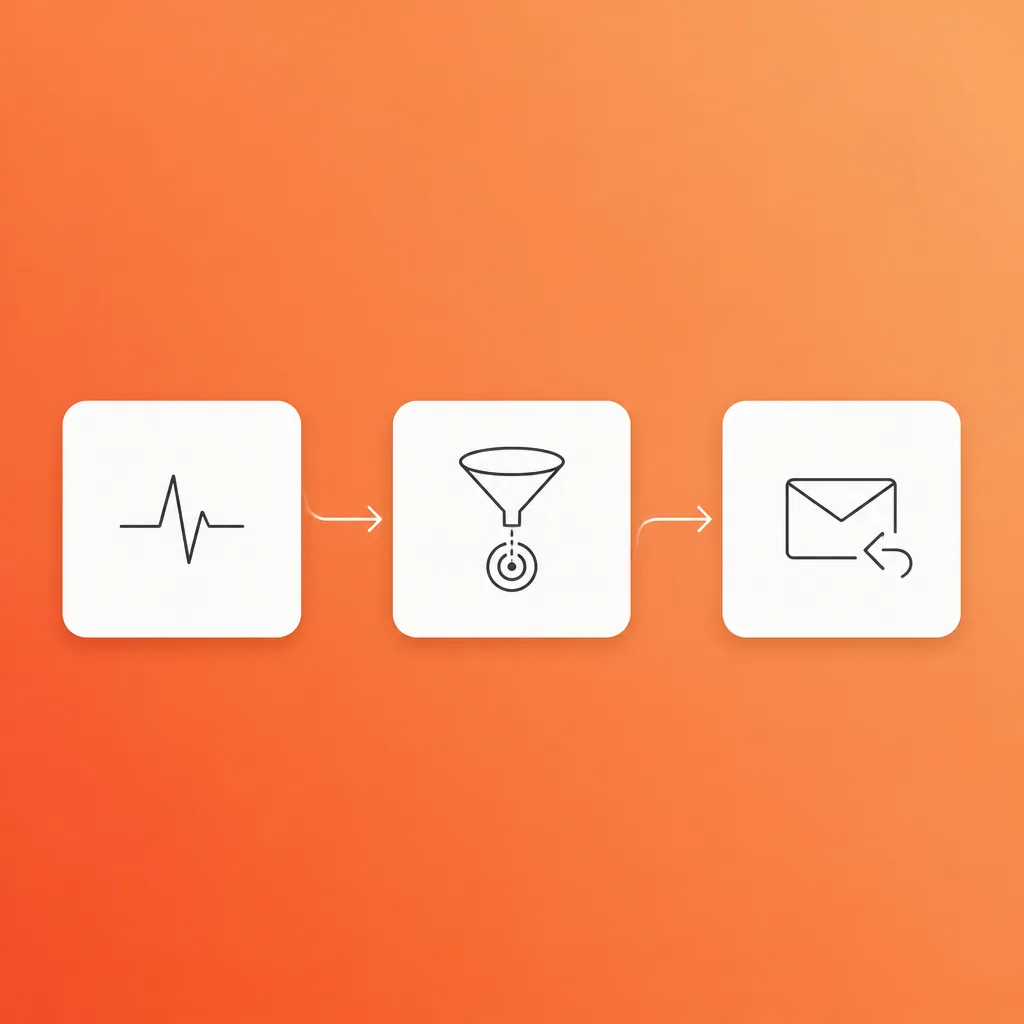
Most B2B churn works this way. Nobody cancels, the customer just stops engaging. Teams that win back customers consistently catch the drift early because a workflow is watching the signals. An AI system reads email engagement, product usage and support contact together, flags an account the moment it crosses the line, and tells you who gets a sequence and who gets a call.
Why B2B churn is silent
Most churn models assume an event. In B2B the customer just stops engaging. Userpilot's 2026 benchmarks put median B2B SaaS monthly churn around 3.5 per cent, and Projetly's breakdown says 60 to 80 per cent of that loss is voluntary. The customer drifts away, and no failed payment ever flags it.
The list is quietly shrinking too. ZeroBounce's 2026 report measures yearly list decay at 23 per cent, with only 62 per cent of addresses verified in 2024 still valid. Alex Berman's re-engagement guide puts decay at 22 to 25 per cent a year, with only about a third of any list engaging in a twelve-month window. The signals live in different systems, and nobody joins them until the account is gone.
The practical version is a small set of signals, each with a clear response.
| Signal | What it looks like | What to do |
|---|---|---|
| Email silence | No opens or clicks for 60 days | Start a check-in sequence, not a sales pitch |
| Usage drop | Logins at half the account's baseline for a month | Flag for a customer success call, not marketing |
| Service goes quiet | Tickets and check-ins stop completely | Ask directly what changed before you guess |
| Renewal in sight | 90 days out, no engagement at all | Start the win-back sequence with a value recap |
How to win back customers with a workflow that detects, segments and sequences
The workflow runs on an AI system that ingests data from your email platform, your CRM and your product logs together, applies one definition of inactivity, and flags an account the moment it crosses the line. It learns what normal looks like per account, so a quiet month does not trigger a false alarm. ActiveCampaign's glossary describes email workflows the same way, as the right message to the right person at the right time, triggered by behaviour.
Detection should lean on clicks, not opens. Apple's Mail Privacy Protection made open tracking unreliable, and Litmus's 2025-2026 research shows serious teams now track revenue per email and list churn instead. Start with 60 days of no clicks and no logins, sending the first email around three months after the last interaction, per ActiveCampaign's win-back guidance.
Segmentation decides whether the sequence feels helpful or desperate. Tier the lapsed list by the last twelve months of revenue. Furlough's win-back research recommends a seven-email sequence with a 20 to 25 per cent offer for mid-tier customers, and human outreach with a stronger offer for the top ten per cent by lifetime value. The accounts that paid the most get a call, a visit or a custom walkthrough.
For everyone else, a three-email sequence over two to three weeks works. BadRep's analysis of 200 win-back emails from 82 brands found the strongest programmes share a shape. Day one re-introduces the value you delivered, day seven adds social proof or a product update, day fourteen makes the final offer with a clear last call.
The message matters more than the offer. The Good, a conversion agency, published win-back experiments at real brands. Autodesk grew subscriptions 11 per cent, The Economist raised paid conversions 5 per cent, and IDX lifted registrations 20 per cent, none built on a discount. Lead with what changed since they left and show proof from similar customers, because discounts train people to leave and wait for the next one. If you run ecommerce, our Klaviyo and Shopify win-back build follows the same shape.
When to stop and clean the list
A win-back workflow needs an ending. Every send to an account that will never return costs you deliverability, because mailbox providers read engagement when placing future mail. Mailgun's research found 78.5 per cent of senders rate deliverability at least 8 out of 10, with engagement behaviour driving inbox placement.
The final email should be an explicit last call saying we will take you off the list if we do not hear from you. It gives the account a reason to respond either way and protects the reachable part of your list. ZeroBounce recommends cleaning at least quarterly. Win-back is one stage of a larger lifecycle, and we have mapped the full email lifecycle for Mailchimp and Salesforce.
There is a legal side. Under Article 6 of the GDPR, reactivation mail is lawful only with consent, contractual necessity or a legitimate interest, and the opt-out has to keep working on every send.
The recovery maths, and what one quiet account is worth
Recovery is a percentage game. Omnisend's win-back research puts success rates between 20 and 40 per cent, with won-back customers often doubling or tripling lifetime value and 47 per cent buying more after returning. Validity's research, cited by Klaviyo, found 45 per cent of win-back recipients open future emails. SaaStr puts well-nurtured B2B churn returns at 8 to 12 per cent, and Sequenzy's estimate puts win-backs at 5 to 25 times cheaper than acquisition.
The compounding effect is the prize. Bain & Company's long-running finding, cited by Snapmint, shows a 5 per cent increase in retention lifts profit by more than 25 per cent. So what does one quiet account cost you? Take your five biggest lapsed accounts, add up last year's revenue, and apply a conservative 10 per cent recovery rate. The result is the low end of what the workflow returns in year one, and it usually dwarfs the cost of running it.
Getting this running takes a few steps.
- Write your inactivity rule in one line, such as 60 days with no clicks and no logins, and set it to trigger automatically.
- Tier the lapsed list by the last twelve months of revenue so the top accounts get a call and the rest get the sequence.
- Calculate what 10 per cent of your five biggest lapsed accounts is worth, and let that number decide how much effort this deserves.
This is something we do at Supernodes. A two-week pilot runs the audit, the connection and the first measurement cycle, and if that sounds like your Monday morning, speak with us.
Frequently asked questions
How long does it take to see results from a win-back workflow?
The foundation can be live in two weeks, covering the inactivity definition, the data connections and the first sequence. The Supernodes pilot runs the full loop of audit, connect, deploy and measure, and most teams see a recovery within a month of the first sends.
What if the win-back emails do not work?
Change the channel before you rewrite the message. Winbackengine, a vendor that sells customer reactivation services, publishes a channel comparison putting human phone calls at 25 to 40 per cent recovery against 2 to 5 per cent for automated email alone. The highest-value accounts get a call, and the automated sequence covers the rest.
Should the offer always be a discount?
The evidence says value first, discount last. The Good's published experiments grew subscriptions without discounts, and Furlough's research reserves a 20 to 25 per cent offer for mid-tier customers, with 30 per cent-plus only for the top ten per cent by lifetime value. If the first two emails get no reply, the offer makes the third worth answering.
How do I tell a drifting account from one that is just quiet?
Watch the combination, not a single number. Order-frequency decay, category contraction and payment-term extension showing up together is a stronger signal than any one on its own. In a subscription business, the equivalent is falling usage plus email silence plus no service contact.
Is it legal to email customers who have gone quiet?
Under Article 6 of the GDPR, reactivation mail needs consent, contractual necessity or a legitimate interest, and the opt-out has to work on every message. Keep the unsubscribe visible and honour it quickly.