
The banner went live on a Tuesday. By month end, the CRM had logged sixty-three signups that traced back to paid search, the ad platforms could account for fewer than half of them, and no two reports agreed on the total. Nobody had touched a campaign; the change that week was consent. Consent mode v2 decides what your tags may still send once a visitor makes a choice.
The orders did not stop arriving, since a visitor who refuses the cookie tier still buys; Google just stops being able to see that the purchase came from the ad. That gap sits under every budget call, including where the next dollar goes.
This guide walks the signal itself, covering what the two consent modes change, what still gets sent when a visitor declines, what the platforms can model back, and what stays missing. If the plumbing underneath is shaky, start with our guide to GA4 conversion tracking through Tag Manager.
Why the numbers went quiet when the banner went up
The banner was the only thing that changed, and that is exactly what the tags react to. Google's tags adjust their behaviour to the visitor's choice, so when advertising and analytics storage are denied, they stop reading and writing cookies and identifiers for those purposes, severing the thread between an ad click and what follows. The click is still recorded; the conversion it caused drops off the map.
Keeping remarketing and audience features working for EEA and UK visitors has required consent mode since March 2024, as the standard technical walkthrough by analytics developer Simo Ahava explains, and June 2026 tightened the advertising side further.
Consent mode v2 in plain language
Consent mode is a signalling layer. It does not collect consent and it does not draw the banner; it carries the choice your banner collected to Google's tags so each one knows what it may do. Google's guide to setting up consent mode on a website names the two moves that matter. Set a default state before any tag fires, then update it the moment the visitor answers.
The signals travel as four parameters. ad_storage covers advertising cookies and analytics_storage covers measurement cookies; ad_user_data and ad_personalization, added with v2 in late 2023, carry instructions about using personal data for advertising and personalised ads. They act downstream and change nothing on the page itself.
The other half is the mode. Basic mode holds the tags back until someone interacts with the banner, so a refusal sends nothing. Advanced mode loads the tags from the first page view with a default you configure, and when consent is missing it still sends limited signals. That design is what makes recovery possible.
What the tags still send when a visitor declines
In advanced mode, a decline does not silence the tags. They send what Google calls cookieless pings, and the composition is thin, carrying consent state, notice that a key event happened, and coarse signals such as a timestamp, whether an ad click identifier appeared in the URL, and a random number generated per page load. No cookies, no identifiers, nothing that follows a person between sites; Google's consent mode modelling notes confirm that the pings are never used to track individuals, build remarketing lists or generate user profiles.
Turn the pings off and Google cannot build advertiser-specific calibration, which degrades the models. Basic mode sends nothing at all until consent arrives, leaving a general model on the advertising side and no behavioural modelling in GA4.
Set the states side by side and the recovery maths becomes visible:
| Consent state | What the Google tags send | What Google can put back |
|---|---|---|
| Granted | Full measurement, with cookies and identifiers read and written | Nothing to estimate; conversions are reported as measured |
| Denied, advanced mode | Cookieless pings carrying consent state, key-event notices and coarse page signals | Advertiser-specific modelling of conversions in Google Ads and behaviour in GA4, once thresholds are met |
| Denied, basic mode | Nothing, not even the consent status; the tags stay blocked | A general model in Google Ads; no behavioural modelling in GA4 |
| Not set | The system starts from its consented default until the banner's first update lands | Nothing is flagged; early activity is recorded with the state the tags started from |
The visitor decides the choice; your configuration decides what the choice costs you.
What conversion modelling can put back
Modelling is the estimation layer that steps in where cookies cannot connect the journey. Google's explanation of consent mode modelling in Google Ads describes it as analysing observable data and historical patterns, then using consented journeys to assess attribution paths for the rest, and the output feeds Smart Bidding from the Conversions column. Early results published by Google said modelling recovers more than 70 percent of ad-click-to-conversion journeys lost to consent choices, on average, with wide variation between advertisers. The figure comes from the company that sells the ads being modelled, and Google adds that consented users are typically two to five times more likely to convert.
Eligibility decides whether you get the advertiser-specific version. The ads side wants consent mode done correctly, or the IAB version Google accepts as an alternative, plus 700 ad clicks over a seven-day window per country and domain grouping; past that the models train and performance improves gradually. For GA4, behavioural modelling asks for consent mode on every page, 1,000 events a day with denied analytics storage for seven days, and a thousand daily consented users across at least seven of the past 28 days.
Estimation has edges. Models avoid over-prediction, so some real conversions stay unaccounted for; in GA4, modelled data skips audiences, several exploration types, retention reports, predictive metrics and BigQuery exports; and everything depends on the quality of the signals beneath it.
The setup checks that decide what you can recover
Most recoverable value is decided before the modelling runs, when the tags and the banner were first wired together. These are the checks, in order.
The default fires before any tag does
The default consent state has to be declared before the Google tags load. Reverse the order and the first events of every visit go out without a state attached. The update arrives when the visitor answers the banner, and that update is what the pings and models key off.
The same state covers every page
Consent mode has to be detected everywhere before modelling performs. The same global tag on every template, the default call firing on all of them, the update call wherever the banner can appear. Gaps on a landing template or a checkout step shrink the modelled picture where conversions are least replaceable.
All four signals travel from the banner
A platform wired for v2 sends all four parameters together. Banner tools still shipping the two storage signals run an incomplete integration, and after June 2026 the ad_storage signal carries more weight in Google Ads than it used to.
The impact report shows what the models recovered
Google Ads reports the modelling uplift at domain-by-country level, and the help page on consent mode impact results shows the two paths to it through the Conversions summary and the Diagnostics tab. The metric refreshes weekly, and each domain and country slice only carries a report for four weeks after its modelling start date. An empty report usually means a country below the volume threshold, a setup younger than seven days, or an uplift under one percent. Tag Assistant shows whether the states are moving.
Choosing a consent tool without overpaying
The tool decision is plumbing first. A platform earns its place on this job if it emits all four signals, sets default states in the right order, and appears on Google's list of certified consent management platforms.
The banner also decides your consent rate, and therefore the data you keep. France's privacy regulator studied 1,000 of the country's most-visited websites and found 59 percent of visitors accepted and 39 percent refused once the reject button carried equal weight to accept, as summarised by PrivacyTerms, a vendor of privacy compliance documents. More than 475 million euros in privacy fines landed during 2025, and the CNIL's September 2025 actions against Google and Shein centred on consent flows that made accepting the easier click.
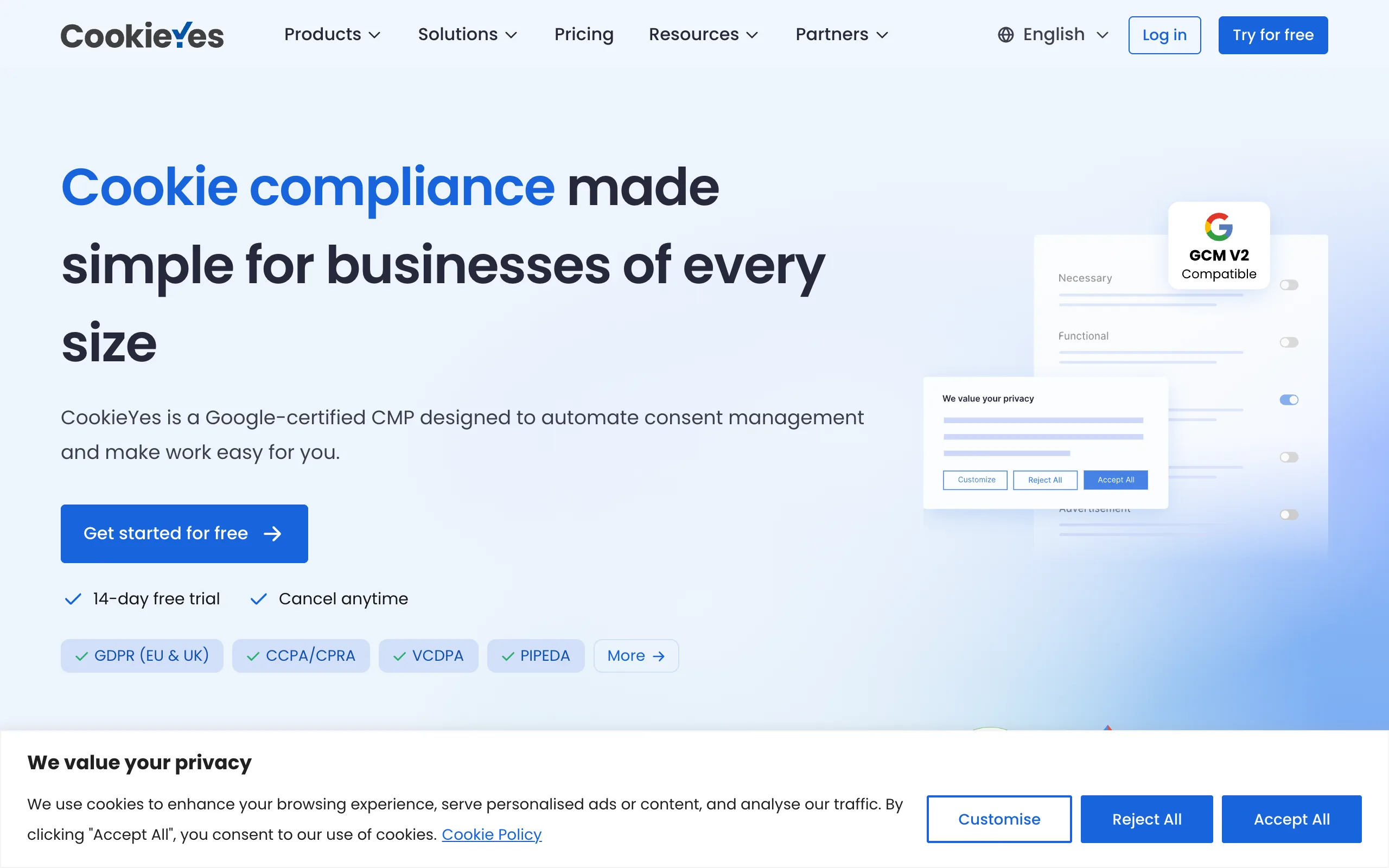
The consent banner running on CookieYes's own site, with Reject All alongside Accept All, captured on 19 September 2026.
On price, the entry tiers tell the story. CookieYes publishes a free plan to 5,000 pageviews a month and USD 10 a month for 100,000, while iubenda lists EUR 4.99 a site a month at 25,000 pageviews on yearly billing. A mid-tier plan with headroom beats both extremes.
Before committing, check the wiring inside the tool, meaning how it sets defaults, which signals it emits, and whether it keeps a consent log. The rest is banner design you can tune in an afternoon.
Where the remaining gaps show up in reporting
Fully wired, the numbers still will not match, and knowing where the seams sit saves time. GA4 surfaces modelled data only through the blended reporting identity, and only in reports that support it. Google Ads rolls modelled conversions into the Conversions column. Your CRM counts outcomes that neither platform ever saw, including anonymous sales that never carried a click identifier or a consent state.
The mismatch grows when you compare markets. US audiences accept at far higher rates under opt-out models, often above 80 percent, while German and French audiences refuse more often, per the benchmark data collected by Kukie, which sells consent management software. One global consent rate hides wide differences, and reporting by country keeps modelled and measured data legible together. It is the same reconciliation problem that runs through multi-channel attribution across Google, Meta and LinkedIn.
Two other channels deserve wiring once the consent side is clean. When the conversions you care about close in the CRM, nothing reaches the ad platform unless you send it, and offline conversion tracking with Zapier covers that path. When you want the query side of search to feed content decisions, turning search-term reports into content changes is the next project. Both extend the same measurement chain, so both depend on the consent signal being right.
And the reallocation question waits on all of it. You cannot decide where the next dollar goes from reports with a hole this size in them, so fix the signal, read the impact report, then move the budget.
Keeping the setup current as privacy rules shift
Consent plumbing rarely stays still, and 2026 has already produced one substantive change. On 15 June 2026, Google made ad_storage the single control over advertising data reaching Google Ads, removing the dual control it shared with the Google Signals toggle. OneTrust's write-up of the change, from a company that sells consent management, lists what to review, covering ad_storage defaults, the completeness of the four signals, and anything that had relied on Signals being switched off. The write-up also notes that Google confirmed a 90-day extension for advertisers updating disclosures or tags.
The maintenance habit is small and quarterly. Re-check the firing order after any template release. Watch the consent rate for sudden moves. Re-run the impact review after big campaign launches. Keep an eye on the rules themselves, since the IAB framework Google accepts as an alternative signal source keeps revising. One boundary is worth restating along the way; wiring the signals correctly does not by itself make a site compliant, and lawful bases, banner fairness and how refusals are honoured sit in the legal track beside your measurement work.
Work out what the blind spot costs you
Recovering the numbers is worth different amounts to different businesses, so run the arithmetic on your own account. Start with last month's conversion count. Ask your consent tool for the refusal rate on the same traffic; across the studies above, two fifths to two thirds of sessions is the normal refusal range in markets where banners bite. Apply that share to the conversions, since it is roughly the slice the platforms cannot see in full, and multiply by your average conversion value.
The result is the size of the blind spot your bidding has been working around, and the number to weigh against the fix, which for most sites is a few days of configuration and a subscription in the low tens a month.
Three moves get you started this week:
- Confirm all four signals leave your banner and arrive at the tags.
- Open the impact report and note what the models already credit.
- Fix the firing order if the default runs late.
Each is a settings change, which is why the fix is usually cheaper than the guesswork it removes.
This is the kind of signal work we do at Supernodes, usually as a two-week pilot that audits the consent setup, connects the pieces and measures what comes back. If a recovered conversion picture sounds worth having, speak with us.
Frequently asked questions
What is consent mode v2?
Consent mode v2 is the signalling layer between your cookie banner and Google's tags. It carries each visitor's choice, granted or denied, across four parameters covering advertising storage, analytics storage, advertising user data and ad personalisation, and every tag adjusts what it may do. It does not collect consent or display a banner.
What is the difference between basic and advanced consent mode?
Basic mode keeps Google's tags from loading until someone interacts with the banner, so a refusal sends nothing. Advanced mode loads the tags with a default state you configure, sends cookieless pings when consent is denied, and updates when the visitor answers. Advanced mode is what makes advertiser-specific modelling possible.
Can Google Ads recover conversions when people decline cookies?
Partially, through conversion modelling. When cookieless pings are flowing, Google estimates the ad-click-to-conversion journeys that cookies can no longer connect. Its early results claim more than 70 percent of lost journeys recovered on average, and Google notes that outcomes vary widely with consent rates and setup quality.
How long does modelling take to start working?
Google Ads needs 700 ad clicks over a seven-day window per country and domain grouping before its models train. GA4 asks for 1,000 events a day with denied analytics storage across seven days, plus 1,000 daily consented users across seven of the past 28. The impact report can show uplift as soon as seven days after a correct implementation.
Do modelled conversions change my real orders?
No. Modelling changes what appears in Google Ads and GA4 reporting; the orders, signups and deals in your own systems stay as recorded. Modelled conversions do feed Smart Bidding, which is the point, because the bidding then optimises against a fuller picture of what your spend achieved.
Does consent mode v2 apply outside the EEA and the UK?
The requirement is tied to the EEA and the UK, where consent mode has been needed since March 2024 to keep audience and remarketing features working. The signals behave the same everywhere, and most global sites run one implementation, but how much data disappears depends on where your visitors are and how the banner is configured.