A budget gets signed off on Monday. By Friday there are twelve ad variations live, a running argument about which one is carrying the account, and no answer to the question that decides next month's spend, which creative earned the sale.
Meta ads creative testing usually stops right there, and the reason has nothing to do with talent. Nobody wrote down what would count as an answer before the ads went live. There was no rule about which variable was changing, no window for when the verdict would land, no threshold for calling a winner and no plan for what the winner would get. Take those four decisions away and a test turns back into spending, only with more opinions attached.
Two jobs sit next to this one. Generating the variations in the first place belongs to our guide on AI ad creative testing across Meta and Google, and working out what each variation costs to produce is the subject of the ad creative cost breakdown. This post holds the judging discipline, and it assumes one platform, a modest budget and an account that cannot currently tell which creative earned which result. The framework below runs in order, from the setup decisions through to what happens to the winner and the loser.
Why Meta ads creative testing usually ends without an answer
Every impression Meta serves is contested. The company's own auction explainer (Meta sells the advertising in question) describes an auction that weighs more than the highest bid, and lists five components that strong outcomes combine, the objective, the targeting, a sufficient budget, enough duration and the creative itself. Four of the five are settings an account fixes before launch. The creative keeps changing all month, and it is the one most accounts cannot read.
The harder problem sits in how the system handles concurrent ads. Meta's guidance on A/B testing makes a point few account owners have read. When several campaigns or ad sets run side by side without the testing tool, the system treats them as a combined group, and delivery along with budget distribution ends up skewed. Under that arrangement two ads competing for the same budget blur together, and nobody can say which one earned the purchase.
Even inside a single ad set, delivery will not stay even. Jon Loomer, who sells Meta advertising training and audits, notes that ads in a set are not shown equally, that the delivery system makes its decisions quickly, and that in most cases the difference between two ads will not be statistically significant. The platform is telling you the gap is often noise. No dashboard can turn noise into a verdict.
The cost of a bad read keeps rising. Opascope, an agency publishing from audits of more than 200 accounts, puts Meta CPMs up 30 to 40 percent year on year across its sample, which means weak creative wastes more budget than it did two years ago. Meta's quarterly results for June 2026 (the company reports on the marketplace it sells into) showed the average price per ad up 12 percent year on year. Against that backdrop, the unreadable test is the expensive kind of habit.
The pattern repeats across accounts of every size, and it points to a small fix. Write the decision down before the test starts.
One platform, one budget, one decision rule
Pick one platform and keep the test on it. A test that runs across Meta and Google at once is two tests sharing one budget, and the two channels answer different questions at different speeds. Reading them together is its own project, the one our guide to unified ad attribution across Meta, LinkedIn and Google takes on. A creative test needs one clean signal, and a single auction supplies it.
Testing earns its own budget line. Grow with BA, a performance agency, recommends sending 10 to 15 percent of monthly spend to net-new creative testing, and holding it as a standing line of the account. Superscale's benchmark roundup puts the market range at 10 to 20 percent on testing against 80 to 90 percent on scaling, with the testing share rising as spend grows. On a monthly budget of a few thousand, the line is a few hundred, and that is enough to learn with.
Whatever the number, four decisions go on one page before launch, covering which variable is changing, how long the test runs, what counts as a win, and what happens to the winner once it is found. The rest of this guide fills each one in. Miss one and the account ends up right where it started, with twelve variations and a shrug.
Meta ships a tool for this work. Its Business Help Centre describes a creative test that compares up to seven variations, set up inside an existing campaign so winning ads keep their delivery learnings after the test ends. The walkthrough is short. Open the campaign, go to the ad level, find the Creative test section, choose two to seven copies of the ad, then decide how much of the campaign budget the test may spend. Meta suggests capping it around 20 percent so the test does not distort the campaign it sits inside. When the test ends, the results arrive by email.
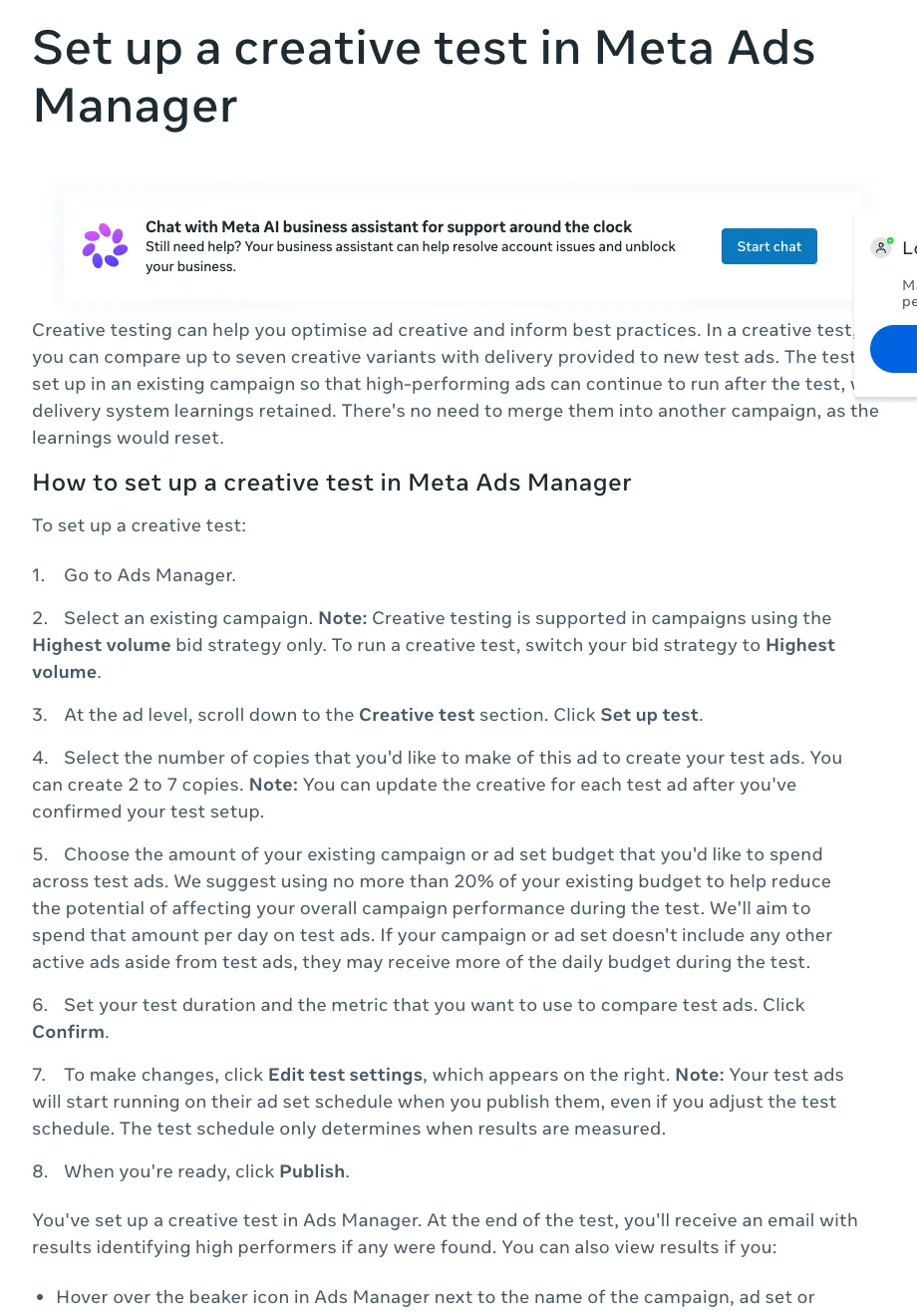
The creative test setup in Meta's Business Help Centre, from opening the campaign to publishing the test, captured on 22 September 2026.
What to test first: the variable ladder
The ladder orders what to test. Big swings sit at the top, small refinements at the bottom, and the discipline is to work down one rung at a time. Most accounts skip straight to the bottom because the little tests feel safe, then wonder why nothing they learn moves the account.
Start with the whole concept
Concept-level differences are where the wins live. Segwise, a creative analytics vendor, relays Nielsen research putting creative quality behind roughly 56 percent of a campaign's sales lift, well ahead of placement and audience choices. Opascope's reading of Meta's Andromeda delivery update adds a practical constraint. Hook-only variation now reads as a single signal, so tests have to vary whole concepts before the system treats them as distinct.
Change one variable per test
Below the concept sit the hook, the offer and the audience. The hook is the first frame or first line that stops the scroll, the offer is what gets promised at what price, and audience and placement come last for a practical reason, since delivery has grown good at finding people for a strong creative and cannot rescue a weak one. Descend only as far as the account needs. A concept that wins gets its hook tested next quarter. A hook that wins inside a losing concept goes in the log, filed under the concept that could not carry it.
Wherever a test sits on the ladder, one variable moves at a time. AdLibrary's practitioner guide names two variables changed in a single test as a top failure mode. Bravery Technology's list of common mistakes opens with the same item, alongside conclusions drawn from three days of data and budgets too small to reach significance. Run the whole test with a single change and the result points somewhere. Run it with two and the account learns nothing it can use.
Keep the field small as well. Jon Loomer cites Meta's recommendation of no more than six ads in an ad set, and that figure is a ceiling worth respecting, because delivery spreads thin past it. Three to five variations, each built around a genuinely different idea, gives the delivery system a real choice and the person reading the results a real comparison.
How long to run a test before judging
Time and events set the answer, and neither arrives on the first day. Meta runs a learning phase for every ad set while the delivery system explores who should see it, and the phase has a shape worth knowing before anyone reads a result.
The floor is a full week
Jon Loomer's explainer on the learning phase is the reference most accounts use. An ad set optimised for conversions wants around 50 conversions inside its first seven days to settle, and the figure applies per ad set. While it runs, the Delivery column says Learning, and the numbers underneath are still moving. Segwise's framework sets the floor at seven days for another reason, so the test covers a full weekly cycle and buyer behaviour does not get read as a result. Meta's split test guidance, as recorded in Jon Loomer's walkthrough, recommends schedules of three to 14 days. Put those together for a modest account and the working window is one to two weeks. Where 50 conversions sits out of reach, the honest response is fewer variants and a longer window, since a shrunken sample answers a different question.
Money has a floor too. Adligator's budget testing framework puts the floor at three times the target cost per result in spend before anyone judges the test, and Grow with BA warns that killing a creative too early, on too little spend, throws away potential winners to random noise. Zeely's budgeting guide treats a single day of numbers as unreliable, because audience size, time of day, delivery pacing and plain randomness all show up in it.
Leave the running test alone
Edits during the window reopen the learning phase, which is why Winning Hunter's campaign rules for tests include no edits during the test window, and why Jon Loomer's piece on edits that trigger learning ends up on every checklist. Meta's own example, relayed there, treats a tiny budget nudge as harmless and a tenfold change as a real risk to learning. Schedule the edit for the day after the verdict and nothing gets disturbed.
The rule for calling a winner
Decide the metric before launch, and pick the one closest to money that the account has the volume to support. That usually means purchases for a store, or booked demos for a B2B account. Judging a test on click-through while the business runs on purchases is how a cheap-looking winner turns out to be an expensive one.
Two numbers govern the verdict, events and confidence, and the practitioner floors cluster. For events, Segwise asks for at least 50 conversion events per variant, AdLibrary wants at least 100 conversions per variant on conversion tests with 50 clicks as the fallback where volume is thin, and Surfside PPC frames the same idea as roughly 50 optimisation events per week so each variant can leave the learning phase behind. For confidence, Segwise treats about 80 percent as the level to act on and 95 percent as the level to commit budget behind, and AdLibrary's guide wants 90 to 95 percent before a winner is declared. Meta's A/B testing tool reports a confidence figure with its results, per AdLibrary's guide, so the maths can live in the tool.
The table below is the framework in one view. Read it top to bottom when a test ends.
| Variable on test | How long to run | The rule for judging | What happens next |
|---|---|---|---|
| Creative concept, the whole idea | One to two weeks | Lowest cost per result after at least 50 events per variant and a confidence figure above 90 percent | Keep it running and scale budget 20 to 30 percent every two to three days |
| Hook, the first frame or line | One full week | Better click-through that holds up alongside a stable cost per result | Carry the winning hook into the next concept test |
| Offer, meaning the price, proof or promise | Two weeks, or until the events floor is met | Winner needs the same events floor at 90 percent confidence; below 80 percent, decide nothing | Move the winning offer into the scaling pool |
| Audience or placement | One full week | A gap the tool will not flag as a leader counts as a draw | Log the draw and widen the difference next time |
When the tools will not flag a leader, the draw is the honest verdict, and the next move is to widen the difference between variants. Grow with BA's creative testing framework opens with the classic version of getting this wrong, where two creatives run head to head on USD 500 of spend and a winner gets declared on a 5 percent click-through difference. At that spread, the result is a coin that landed on its edge, and the account will spend the next month acting as if it learned something.
What to do with a winner, and with a loser
Growing the winner without resetting it
A winner starts a budget conversation. Keep the winning ad running and grow its budget in steps. Adligator's guidance is 20 to 30 percent every two to three days, and Twelverays gives the same shape, no more than 20 to 30 percent every few days. Both warn against the overnight double, which reopens the learning phase and can undo what the test just proved. DigitalSMB's small-business guide frames the risk from the other end and notes that large daily jumps often hurt short-term performance.
A proven winner also changes the shape of the account. Opascope's working split keeps 80 percent of spend behind proven winners and 20 percent running tests on new concepts, with three to five winners in rotation at any time. The winners carry the month, and the test line finds the next one.
Retire the loser cleanly
A loser is a result as long as the rules were followed. The variant missed the floor, the winner cleared it, and the gap survived the confidence check. The variant killed at 48 hours, or abandoned at four days, teaches nothing, and both habits appear on AdLibrary's failure list. Killed early, a future winner and a dud look exactly the same in the reports, and the account will rerun the same idea next quarter for the same nothing.
The log is what carries the value forward. CreativeOS, which sells design tooling, recommends keeping a creative testing log of every test, its hypothesis, its result and the lesson, funded by a dedicated testing campaign of 10 to 20 percent of ad spend. The log turns single tests into a pattern an account can act on. After a quarter of honest entries, the questions get sharper, because the log starts answering the obvious ones, which hooks resonate with which audience, which offers carry, and which formats fade first.
A worked week in the test log
Here is the framework in motion, for a fictional direct-to-consumer running-shoe brand with round figures that show the sequence of a well-run test. The account sets its events floor at ten purchases per variant, sized to its budget, and stretches the window to a fortnight to reach it.
The testing line is AUD 600 a fortnight, the metric is cost per purchase, and the rules go on one page before launch. Target cost per purchase is AUD 30. Any variant that spends AUD 150 and sits above three times the target gets retired on the spot, a cut agreed in advance so nobody has to make the call in the moment.
The three concepts are a testimonial, a product demo and a price-led offer, each with its own hook and its own promise, all pointing at the same landing page. By Wednesday the price-led variant leads on clicks and the team is tempted to move budget. The written rule says no decisions before the floor, so nothing moves. By day five the demo concept has spent AUD 150 with a single purchase, and the pre-agreed cut retires it. The lesson goes in the log, buyers did not want the demo in this account, at this stage, for this product.
On day fourteen the fortnight closes. The testimonial concept finishes at AUD 21 per purchase across 14 purchases, past the floor and ahead of the target. The price-led variant sits at AUD 30 per purchase on five purchases, tracking the target but short of the floor, so it stays live as the challenger. The testimonial wins on the written rule, the only variant past the events floor, and the margin clears the confidence check. The next actions were agreed in advance as well. The winner keeps running with a 25 percent budget increase every three days while the numbers hold, and the next test opens one rung down, testing a new hook inside the winning concept.
Nothing in that week was clever. The rules did the work, the floor stopped a Wednesday panic, the pre-agreed cut retired a losing variant without a meeting, and the verdict arrived with a number attached. This is the kind of system we set up at Supernodes, usually as a two-week pilot that writes the decision rules, sets up the test structure and runs the first round with your team. If you would like every test to end with a number and a next step attached, speak with us.
Frequently asked questions
How many creative variations should one test run?
Three to five is a workable field for most accounts, and Meta's creative test tool accepts up to seven copies of an ad. The instinct to load in ten has a cost, because delivery spreads unevenly once the field gets wide, and Jon Loomer cites Meta's recommendation of no more than six ads in an ad set. Fewer variations with bigger differences beat more variations with smaller ones.
How long should a Meta creative test run?
A full week is the floor and two weeks is common. Seven days covers a full weekly cycle and gives the learning phase what it needs, which Jon Loomer's guide puts at around 50 conversions in an ad set's first seven days for conversion optimisation. Meta's split test guidance records schedules of three to 14 days. Where events come slowly, stretch the window and cut the number of variants.
How much do I need to spend before I can judge a test?
The published floors cluster around the same numbers. Segwise puts it at USD 300 to USD 500 of spend per creative plus 50 conversion events. AdLibrary wants at least 100 conversions per variant on conversion tests, or 50 clicks where volume is low. Adligator's rule is three times the target cost per result in spend. If the budget cannot reach the floor, run fewer variants over a longer window.
Can I edit an ad while its test is running?
No. Edits during the window can reopen the learning phase, and Winning Hunter's campaign rules for tests list no edits during the test window as a standing requirement. Meta's own example, relayed by Jon Loomer, treats a tiny budget nudge as harmless and a tenfold change as a real risk to learning. Queue the edits and apply them the day after the verdict.
Should I use Meta's built-in creative test or set up my own?
Meta's creative test suits accounts that want even delivery and a results email at the end, and it runs inside an existing campaign so winners keep their learnings. Its limits are documented. The tool cannot pull in existing ads, so testing current creative means duplicating it, and some advertisers have reported uneven spend during tests. A manual A/B setup gives more control over the split while leaving audience overlap, budget balance and significance in your hands, which Bravery Technology lists among the jobs most often done badly.
What should I do when a test ends in a draw?
Treat the draw as a finding and widen the difference next time. Opascope's analysis of Meta's Andromeda delivery update argues that hook-only variations now read as a single signal, so the next test should vary whole concepts. If two genuinely different concepts still finish level, the account may simply be too small for that comparison, and the honest response is a longer window or a bigger offer difference.